
|
The Laplace transform is an integral transform perhaps second only to the Fourier transform in its utility in solving physical problems. The Laplace transform is particularly useful in solving linear ordinary differential equations such as those arising in the analysis of electronic circuits. The (unilateral) Laplace transform
(1) where
(2) (Oppenheim et al. 1997). The unilateral Laplace transform
The inverse Laplace transform is known as the Bromwich integral, sometimes known as the Fourier-Mellin integral (see also the related Duhamel's convolution principle). A table of several important one-sided Laplace transforms is given below.
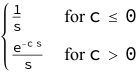
1
In the above table,
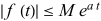
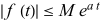
The Laplace transform has many important properties. The Laplace transform existence theorem states that, if
(3) for all
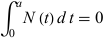
(4) then Lerch's theorem guarantees that the integral
(5) vanishes for all
(6) The Laplace transform is linear since
(7)
(8)
(9) The Laplace transform of a convolution is given by
(10) Now consider differentiation. Let
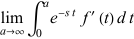
(11) This can be proved by integration by parts,
(12)
(13)
(14)
(15) Continuing for higher-order derivatives then gives
(16) This property can be used to transform differential equations into algebraic equations, a procedure known as the Heaviside calculus, which can then be inverse transformed to obtain the solution. For example, applying the Laplace transform to the equation
(17) gives
(18)
(19) which can be rearranged to
(20) If this equation can be inverse Laplace transformed, then the original differential equation is solved. The Laplace transform satisfied a number of useful properties. Consider exponentiation. If
(21)
(22)
(23) The Laplace transform also has nice properties when applied to integrals of functions. If
|


=int_0^inftyf(t)e^(-st)dt,](http://mathworld.wolfram.com/images/equations/LaplaceTransform/NumberedEquation1.svg)


=int_(-infty)^inftyf(t)e^(-st)dt](http://mathworld.wolfram.com/images/equations/LaplaceTransform/NumberedEquation2.svg)
](http://mathworld.wolfram.com/images/equations/LaplaceTransform/Inline5.svg)

](http://mathworld.wolfram.com/images/equations/LaplaceTransform/Inline7.svg)


![R[a]>-1](http://mathworld.wolfram.com/images/equations/LaplaceTransform/Inline16.svg)


![s>|I[omega]|](http://mathworld.wolfram.com/images/equations/LaplaceTransform/Inline24.svg)


![s>|R[omega]|](http://mathworld.wolfram.com/images/equations/LaplaceTransform/Inline27.svg)


![s>|I[omega]|](http://mathworld.wolfram.com/images/equations/LaplaceTransform/Inline30.svg)


![s>a+|I[b]|](http://mathworld.wolfram.com/images/equations/LaplaceTransform/Inline33.svg)




](http://mathworld.wolfram.com/images/equations/LaplaceTransform/Inline52.svg)


=L_t[F_2(t)](s)=f(s),](http://mathworld.wolfram.com/images/equations/LaplaceTransform/NumberedEquation4.svg)


![L_t[af(t)+bg(t)]](http://mathworld.wolfram.com/images/equations/LaplaceTransform/Inline57.svg)

![int_0^infty[af(t)+bg(t)]e^(-st)dt](http://mathworld.wolfram.com/images/equations/LaplaceTransform/Inline59.svg)





![aL_t[f(t)]+bL_t[g(t)].](http://mathworld.wolfram.com/images/equations/LaplaceTransform/Inline65.svg)
![L_t[f(t)*g(t)]=L_t[f(t)]L_t[g(t)]
L_t^(-1)[FG]=L_t^(-1)[F]*L_t^(-1)[G].](http://mathworld.wolfram.com/images/equations/LaplaceTransform/NumberedEquation7.svg)


=s^nL_t[f(t)]-s^(n-1)f(0)-s^(n-2)f^'(0)-...-f^((n-1))(0).](http://mathworld.wolfram.com/images/equations/LaplaceTransform/NumberedEquation8.svg)
](http://mathworld.wolfram.com/images/equations/LaplaceTransform/Inline70.svg)



![lim_(a->infty){[e^(-st)f(t)]_0^a+sint_0^ae^(-st)f(t)dt}](http://mathworld.wolfram.com/images/equations/LaplaceTransform/Inline75.svg)


![lim_(a->infty)[e^(-sa)f(a)-f(0)+sint_0^ae^(-st)f(t)dt]](http://mathworld.wolfram.com/images/equations/LaplaceTransform/Inline78.svg)


![sL_t[f(t)]-f(0).](http://mathworld.wolfram.com/images/equations/LaplaceTransform/Inline81.svg)
=s^2L_t[f(t)](s)-sf(0)-f^'(0).](http://mathworld.wolfram.com/images/equations/LaplaceTransform/NumberedEquation9.svg)

-sf(0)-f^'(0)}+a_1{sL_t[f(t)](s)-f(0)}
+a_0L_t[f(t)](s)=0](http://mathworld.wolfram.com/images/equations/LaplaceTransform/NumberedEquation11.svg)
(s^2+a_1s+a_0)-sf(0)-f^'(0)-a_1f(0)=0,](http://mathworld.wolfram.com/images/equations/LaplaceTransform/NumberedEquation12.svg)
=(sf(0)+f^'(0)+a_1f(0))/(s^2+a_1s+a_0).](http://mathworld.wolfram.com/images/equations/LaplaceTransform/NumberedEquation13.svg)
=F(s)](http://mathworld.wolfram.com/images/equations/LaplaceTransform/Inline82.svg)


=F(s-a)](http://mathworld.wolfram.com/images/equations/LaplaceTransform/Inline86.svg)


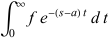


![int_0^infty[f(t)e^(at)]e^(-st)dt](http://mathworld.wolfram.com/images/equations/LaplaceTransform/Inline93.svg)


.](http://mathworld.wolfram.com/images/equations/LaplaceTransform/Inline96.svg)

![L_t[int_0^tf(t^')dt^']=1/sL_t[f(t)](s).](http://mathworld.wolfram.com/images/equations/LaplaceTransform/NumberedEquation14.svg)